History
The Ross Valley Paramedic Authority (RVPA) was established in December 1982 as a Joint Powers Authority (JPA) with eight member agencies. Discussions began in 1980, at a time when the idea of paramedic services was being implemented elsewhere in the County and across the nation.
San Rafael, Novato, Southern Marin, and Marin County fire departments had all started fire-department-based advanced life support systems in the recent past, and “Ross Valley was the last pocket needing service,” said retired Larkspur Fire Chief William Lellis, one of the original RVPA board members. “It was an easy sell to the councils, because of what was going on around us and beyond. The TV show Emergency had recently filmed an episode at the former Hamilton Air Force Base, and it was great PR for the value of paramedics.”
“As Mayor of Fairfax I had been pushing to expand and upgrade our fire and medical response with accredited and licensed paramedics, as the figures showed the largest percentage of our runs, by far, were medical aids, not fires. In 1980 I knew Fairfax could never afford paramedics 24/7, but thought we might throw in with other cities and towns in the Ross Valley as a way of funding it by sharing the costs. I got together with then Fairfax Fire Chief George Hettema, and we called a meeting with representatives from the various towns and fire districts to see if a cooperative agreement to share paramedic services would work,” said Frank Egger, one of the founding board members.
Members were the Towns of Corte Madera, Fairfax, Ross, and San Anselmo; the City of Larkspur; the Kentfield and Sleepy Hollow Fire Protection Districts; and the County of Marin (with respect to certain unincorporated “pockets” in the Ross Valley). The RVPA was formed to provide free paramedic service and ambulance transportation to the nearest hospital for Advanced Life Support (ALS) patients. RVPA was not intended to transport Basic Life Support (BLS) patients in non-life-threatening situations; a private ambulance provider, United Ambulance, was contracted to transport BLS patients for a fee.
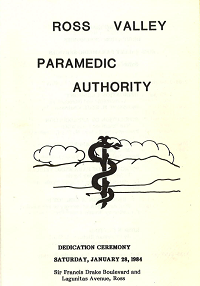
A ballot measure for public funding, Measure “A,” easily passed in each community on June 6, 1983. The measure required two-thirds voter approval and won with 89.1% in favor. The initial tax was $25 per household, and the first annual budget was estimated at $350,000. Service began on January 1, 1984, and a dedication ceremony was held at the Ross Fire Station on January 28, 1984. The first call was for a motorcycle accident in Kentfield.

The RVPA ambulance was stationed in Ross due to its central location. The Leonard and Beryl Buck Foundation provided a $120,000 grant to purchase an ambulance and create a “dry period” reserve to cover expenses between when the initial tax was levied and when it was collected and disbursed. An ambulance was leased from the Southern Marin Paramedic Authority for the first few months until the newly built RVPA ambulance arrived from Ohio in March 1984. It was dedicated in memory of Jay Ingels, a driving force in obtaining paramedic service in the Ross Valley.
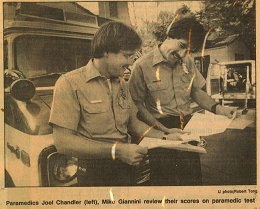
Six paramedics were hired from an applicant pool of 125: Joel Chandler, Michael Giannini, Paul Hager, Steve Oman, Gary Petretto, and Erin Reed. Ron Alves was hired as Paramedic Supervisor, and Corte Madera Fire Chief Robert Shearer served as Staff Advisor. Jerrold R. Gonce was the Executive Officer, and Linda Brandelius served as Secretary. “Early challenges included finding our way around the Ross Valley. All six paramedics and I came from outside Marin. While all had plenty of clinical experience, the Ross Valley and the Marin system were new. Once all personnel were hired and went through their certification process and hospital clinical time, we had roughly 30 days to get in service,” said then-Paramedic Supervisor Ron Alves.
Paramedics initially worked a 24-hour shift with a 56-hour average workweek. Compensation ranged from $1,552 to $2,294 a month. Paramedics also began receiving firefighter training that first year and were eventually designated formally as Paramedic Firefighters. In turn, they served as instructors for ongoing Emergency Medical Technician Level 1 training for all career firefighters in the member agencies. “The best part was working with the firefighters already established in the Ross Valley. What a great group of people. They were all very accepting of us and the program,” said Mike Giannini, who today serves as the Battalion Chief in charge of MCFD’s EMS program that manages RVPA’s field services by contract.

In 1984, the RVPA chose to contract with the County of Marin for paramedic service, for several reasons. There was increasing difficulty obtaining medical malpractice insurance, and potential financial challenges from the passage of Proposition 13. The RVPA was also the only non-fire-department-based ALS service in Marin County; Novato, San Rafael, Marin County, and Southern Marin fire agencies had all established ALS services previously that were working well.
Most of the RVPA paramedics transferred to the Marin County Fire Department (MCFD), which staffed the service beginning December 1, 1985, and has done so ever since. The RVPA’s initial maximum tax rate was $25 per home. In 1991, voters approved an increase in the maximum rate to $30 per living unit.

In 1997, following concerns about delayed service to the southern end of the response area, Corte Madera notified the RVPA that it would start its own paramedic and transport service. Corte Madera launched its service in 1998 and today works closely with RVPA through a boundary drop agreement, meaning the two paramedic transport ambulances generally respond with the closest unit and back each other up.
In 2001, the RVPA funded paramedic training for four Ross Valley Fire Department (RVFD) firefighters to enable the first-response engine in Fairfax to deliver ALS engine company paramedic service. In 2002-03, the RVPA funded paramedic training for five additional RVFD firefighters, expanding fire-engine-based paramedic service to San Anselmo and Sleepy Hollow. The program was later enlarged to include the Larkspur Fire Department. The RVPA paid the incremental cost of providing this service.
In 2006, the RVPA commissioned a strategic assessment, which concluded that transport service provided to the seven jurisdictions by a single ambulance stationed in Ross, together with emergency response by fire-engine-based paramedic-firefighters, was an appropriate level of service for the JPA member communities. Of the original six paramedics and supervisor, only a few still work in the overall system: Steve Oman worked about six months and made a career change; Gary Petretto died of a heart attack in his thirties; Erin Reed became a flight nurse and was killed in a helicopter crash in Washington state in 2005; Paul Hager is a Battalion Chief with Corte Madera FD; Joel Chandler and Ron Alves are Captains in Marin County FD; and Mike Giannini is a Battalion Chief managing the Marin County FD EMS program.
The RVPA JPA reached the 25-year milestone in December 2007 and remains an example of a very successful, cooperative public partnership that provides an essential service in the Ross Valley. “I am very proud of the dedication of all those associated with the JPA. From the board members and firefighters to the newer medics, everyone wants excellent patient care to be the priority,” said Mike Giannini.
In memory of Jay Ingels: a driving force in founding RVPA
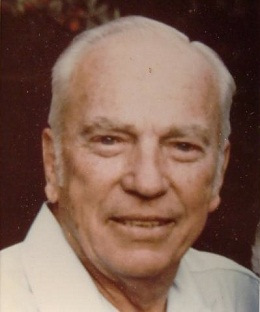
Girard “Jay” Ingels was born in El Paso, Texas, on September 27, 1910. He moved with his family to Southern California and later graduated with a degree in architecture from the University of Southern California. He did not practice as an architect, but applied his knowledge and skills to a long career in the sale of structural steel and service as a building inspector for the County of Marin.
Jay married Amelia Mae (Mickie) Sharp on April 29, 1937. Following the birth of son Gregory in 1943, the family moved to Seattle, Washington, where Jay worked for the Boeing Company during World War II. Their second son, Paul, was born in 1947.
In 1955 the family moved to Marin County and bought their first home in Sleepy Hollow. Even with a young family and a busy career, Jay became involved in community service, serving on the Board of the Sleepy Hollow Homes Association. He later added to his work with the Ross Valley Fire Department.
Jay and Mickie’s family was always a source of joy and pride. Their son Greg was ordained to the priesthood in 1974. Paul and his wife, Dot, were married in 1971 and live in San Rafael. Jay reveled in his two grandsons, Ross and Scott, who both pursued careers in public service, Ross with the California Highway Patrol and Scott with the San Rafael Police Department.
Jay was considered a very important founding leader in the formation of the RVPA. The first RVPA ambulance was dedicated in his memory following his passing in 1983.